
Jacksonville Planning Guide
Bathroom Waterproofing in Jacksonville, FL
Tile is the visible part of a shower, but waterproofing is what determines whether that shower stays trouble-free for years or develops leaks and mold behind the walls. Because so much of this work is hidden once tile is set, it's worth understanding what's happening underneath before your project reaches that phase.
This guide covers the core waterproofing components used in Jacksonville-area bathroom remodels, along with why humidity and ventilation matter as much as the membrane itself.
Call now for service availability. Please have your 5-digit ZIP code ready.
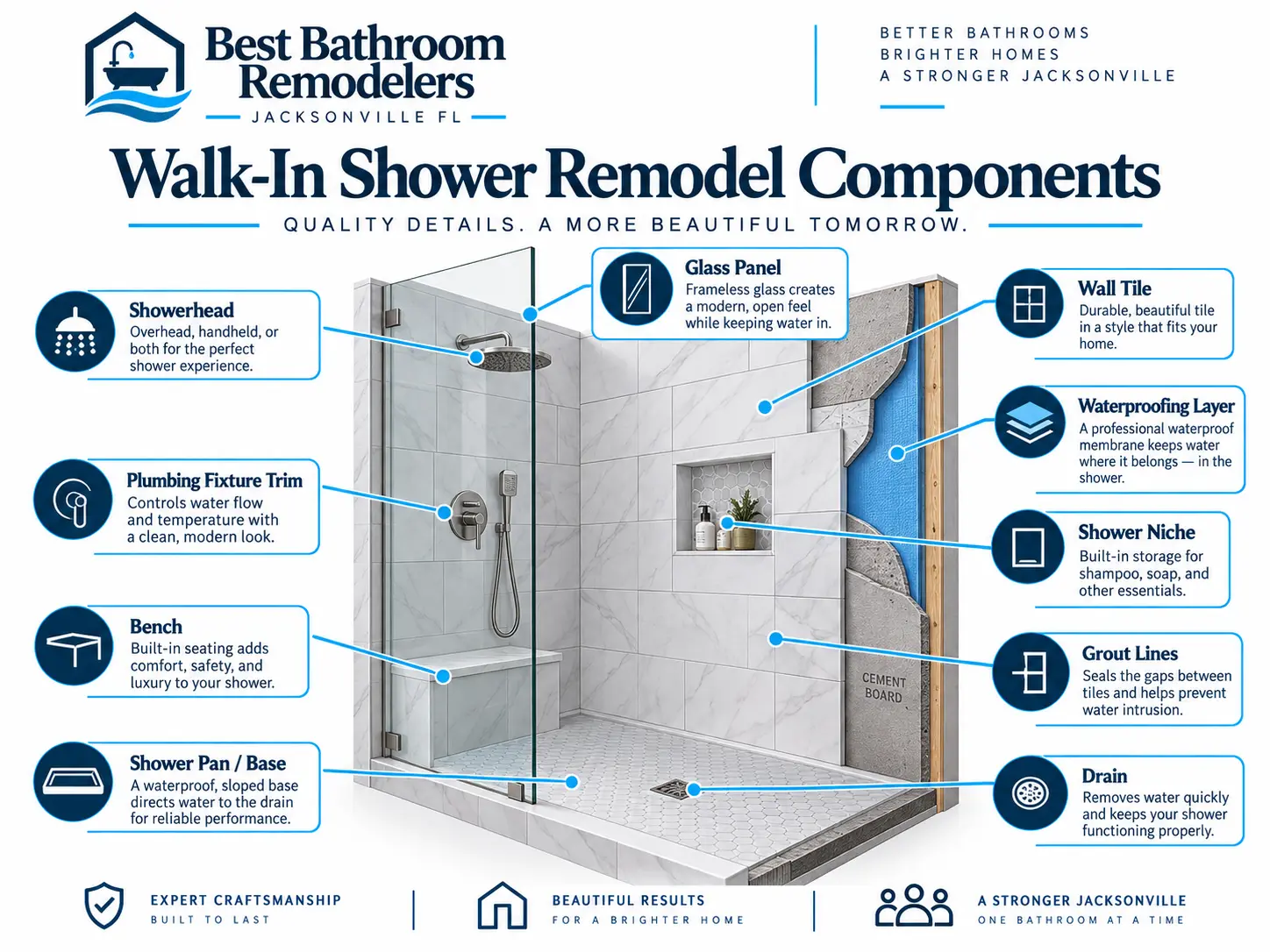
Shower pans and sloped mortar beds
Every shower floor needs a consistent slope toward the drain so water doesn't pool. A traditional approach uses a mortar bed built up and screeded to slope, then waterproofed either over or under the mortar depending on the system. Pre-formed shower pans achieve the same slope with a manufactured base, which can simplify installation for standard sizes but offers less flexibility for custom shower footprints.
Sheet membranes vs. liquid-applied membranes
Sheet membranes are pre-manufactured waterproofing material bonded to the substrate with thin-set, providing a consistent, factory-controlled thickness. Liquid-applied membranes are rolled or trowelled on in wet form and cure in place, which allows them to conform closely to irregular shapes, corners, and transitions like curbs and niches.
Both approaches are widely used, and the right choice often depends on the specific geometry of the shower, the experience of the installer with a given system, and how the membrane needs to tie into the drain and curb assemblies.
Curbs, low-threshold entries, and linear drains
A traditional curb creates a physical dam that keeps water inside the shower, and it needs to be waterproofed and sloped just like the shower floor. Low-threshold and curbless designs remove or minimize that dam for a cleaner look and easier entry, which shifts more responsibility onto slope and drain placement to keep water contained.
Linear drains, often placed along one edge of the shower, can simplify sloping to a single direction rather than sloping toward a center point from four sides, which is part of why they're common in curbless and low-threshold designs.
Niches and benches
Built-in niches and benches are popular for storage and seating, but each one is essentially a penetration into the waterproofed envelope that needs its own sloped floor (in the case of a niche) and continuous membrane tie-in. These details take more time to execute correctly than a flat wall, which is worth factoring into both budget and schedule expectations.
Movement joints
Tile, mortar, and the structure behind them expand and contract at different rates. Movement joints, typically soft caulked joints at changes in plane (like where the floor meets the wall) and at regular intervals in large tile fields, relieve that stress so tile doesn't crack or grout doesn't fail prematurely. Skipping movement joints is a common cause of cracked grout lines that shows up well after installation.
Ventilation and humidity in Northeast Florida
Jacksonville's humidity means bathrooms are working against ambient moisture in the air for much of the year, not just water from the shower itself. A properly sized and vented exhaust fan helps clear humidity after use, which protects paint, grout, and any wood-based cabinetry from long-term moisture exposure.
Waterproofing the shower itself addresses direct water contact, but ventilation addresses the broader moisture load in the room, and both matter for how the finished bathroom performs over time.
Questions
Frequently asked questions
Neither is universally better. Sheet membranes offer consistent factory thickness, while liquid membranes conform more easily to irregular shapes and detailed transitions. The right choice depends on the shower's geometry and the installer's system.
Not when they're detailed correctly, but they do add complexity because each one needs its own sloping and membrane tie-in. Quality of execution on these details matters more than the mere presence of a niche or bench.
They don't always, but a linear drain often simplifies sloping in a curbless or low-threshold design because the floor can slope in one direction toward an edge rather than toward a central point.
Missing or insufficient movement joints are a common cause, since tile and the structure behind it expand and contract at different rates and need a place to relieve that stress.
Yes. Waterproofing protects against direct water contact in the shower, but ventilation manages the humidity load in the rest of the room, which affects paint, grout, and cabinetry over time, particularly in Jacksonville's climate.
Next Step
Planning a Bathroom Remodel in Jacksonville?
Tell us what you want the finished bathroom to do differently, and our team will walk through scope, materials and next steps with you.
Call now for service availability. Please have your 5-digit ZIP code ready.